
What is skimboarding?
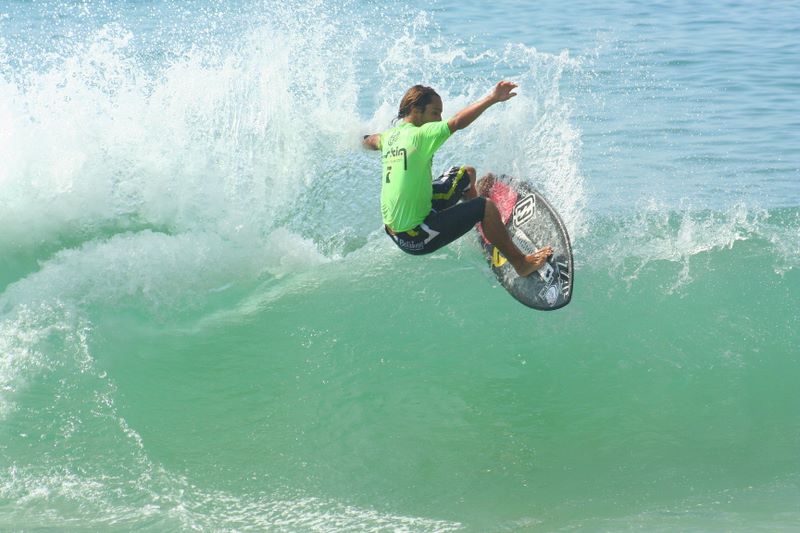
Skimboarding brings together the skills and tricks required to be a top skater, snowboarder and surfer to create a sport which is fast developing a cult following. Though the hybrid sport looks most like surfing, the range of moves which can be made are much higher. What’s more, you don’t need huge surf to skim.
What does a skimboard look like?
In appearances, the skimboard is vastly different to its better-known relation. It is about half the length, half the thickness and slightly wider than a surfboard.
Also, skimboards have no fins, making them much less stable and difficult to control, allowing for tricks which cannot be done on a surfboard. For some help, here is our guide to choosing a skimboard.
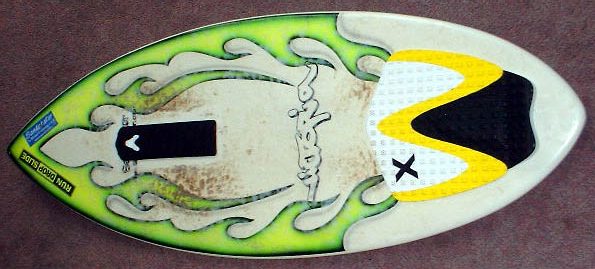
Skimboard Technology
Today, skimboarding is one of the most high-tech water sports. The boards used by professional skimboarders are built to attain maximum lightness & buoyancy.
The technology is adapted from the aerospace industry, and many skimboards are made from carbon fibre, Texalium and fibreglass. To find out more, check out our skimboard contstruction page.
Wave skimboarding
To skimboard, you stand about 6m/20ft from the ocean, on a beach where the waves are crashing directly on the shore. On spotting a decent wave, you run towards it and upon reaching the wet sand, drop your board and jump on as quickly as possible.
You must then remain as stable as possible and prepare to make the transition to the ocean. If you stay on the board, you can glide into the ocean toward the oncoming wave, bank off it and ride it back to shore.
Tricks can be made according to the height of the wave and the skill of the rider. Some of the moves are taken from skateboard parks and ski slopes, making the sport unusual to watch.

Flatland skimboarding
But you don’t need waves to be able to skimboard. You just need a thin film of water of a flat sandy beach. When there are no waves, skimboarders will skim parallel to the shoreline and pull off various moves. This is known as flatland skimboarding.

Skimboard Contests
Skimboarding competitions are increasing in numbers each year. One man has grown to dominate the sport – Bill Bryan, winner of nine world titles and skimboarding’s undisputed king.
Despite his success and the fact the sport has gone professional in the US, the rules governing how it should be judged are yet to be clearly defined. This sport is still finding its feet.
The UK has also seen a rise in skimboarding contests. Sandskater has organised quite few over the years. While Skim UK has organised some of the UK rounds of the European Skimboard Tour at Tolcarne beach in Newquay.
To have a look at the results of some of the UK skimboard contests, you can check out our skimboarding contest results page.

Skimboarding History
It is thought that skimboarding originated in Laguna Beach, California, US, in the 1920’s. Lifeguards used to skimboard on pieces of wood on the shoreline. Although people still skimboard on wood, the sport has evolved immensely. Skimming is taking off around the world, in particular in Japan and Australia.
The man responsible for modernizing skimboarding is Tex Haines, owner of Victoria Skimboards. In the 1970’s, he designed the first foam-core skimboards which made riding a lot easier.
UK skimboarding History
In the UK, Sandskater is at the forefront of skimboarding promotion. Founded by Matt Martin in 2000, the website provided a a UK portal into skimboarding.
Sandskater also supplied skimboards through its online shop. In 2005 Sandskater become a full fledged bricks and mortar store in Paigton, Devon. Unfortunately the shop ceased trading in 2010, but the Sandskater website remained online, where it remained a goldmine of UK skimboarding history.
If you are interested in finding out more about Sandskater, check out our About Sandskater page.